Applying biologicals
Why use biocontrols in horticulture?
The primary reasons for including biologicals in your spray programmes are as follows:
- Residue management is often driven by market demand. Consumers want low, or none at all, chemical residues on the flowers and plants.
- Certifications: Using biologicals allows you to obtain specific certifications to meet market demand.
- Disease and insect control: giving growers the ability to spray without fear of high chemical loads or excessive residues on the end product.
- Filling programme gaps: biocontrols are alternatives in your programmes and should be used in conjunction with traditional crop protection products, which are facing increasing regulatory constraints.
- These will not ease in the future so programme diversification must start now.
How biocontrols fit into an integrated crop program
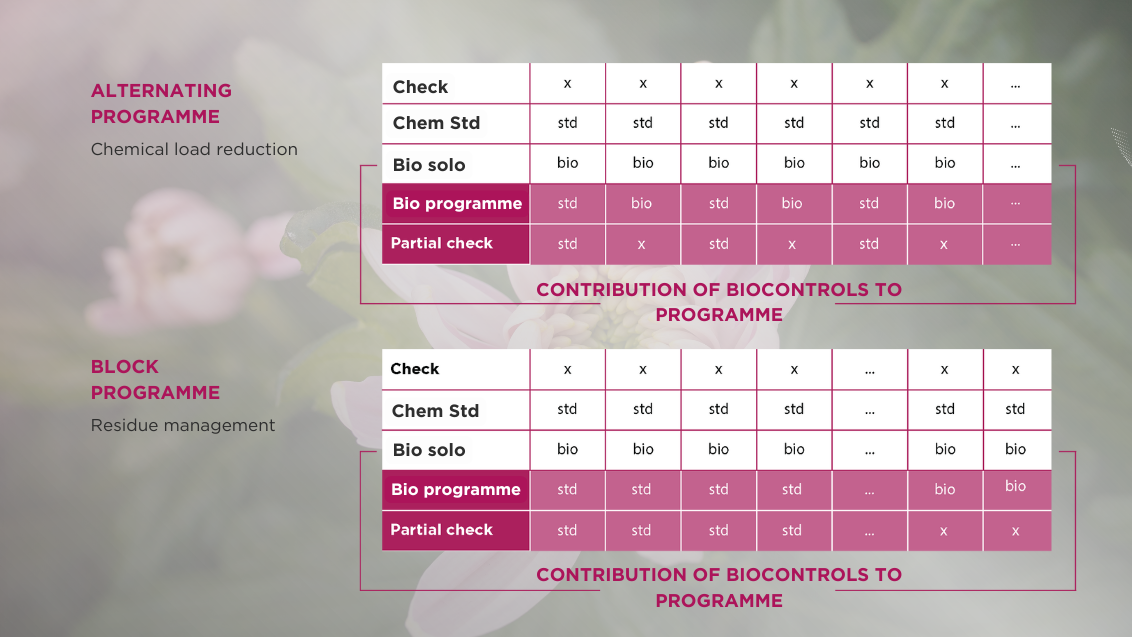
Ornamental crops are usually treated with fungicides several times through the growing season. Biocontrols can be integrated into your control schemes in two possible ways:
Alternating programmes: alternate applications weekly between biocontrols and standard chemical fungicides throughout the season.
Block programme: chemicals and biocontrols are applied in designated blocks of time. Traditional fungicides are sprayed only from emergence to flowering, and then only biofungicides are used from flowering to harvest
Formulation of biologicals
When using biocontrols in combination with other biocontrols, or with crop protection products, special attention should be paid. Biocontrols generally do not have premium formulations, and some contain living organisms that must be kept alive in the tank.
Difference between tank mix and ready-made botanicals
For microbial active ingredients in ready-to-use formulations, it is important they contain living organisms. For botanicals, such as essential oils, it is important that they are not alive. Botanicals are more like chemical products, but their complex and variable composition makes it difficult to formulate homogeneous, stable ready-to-use mixtures.
Impact on bees and beneficial insects
Most microbial biofungicides are harmless to bees and other insects, but not all botanicals are. Plant extracts can perform well on diseases, but their insecticidal properties are problematic for bees and predatory insects. The impact on beneficial organisms can influence their adoption and positioning within a spray programme can be challenging.